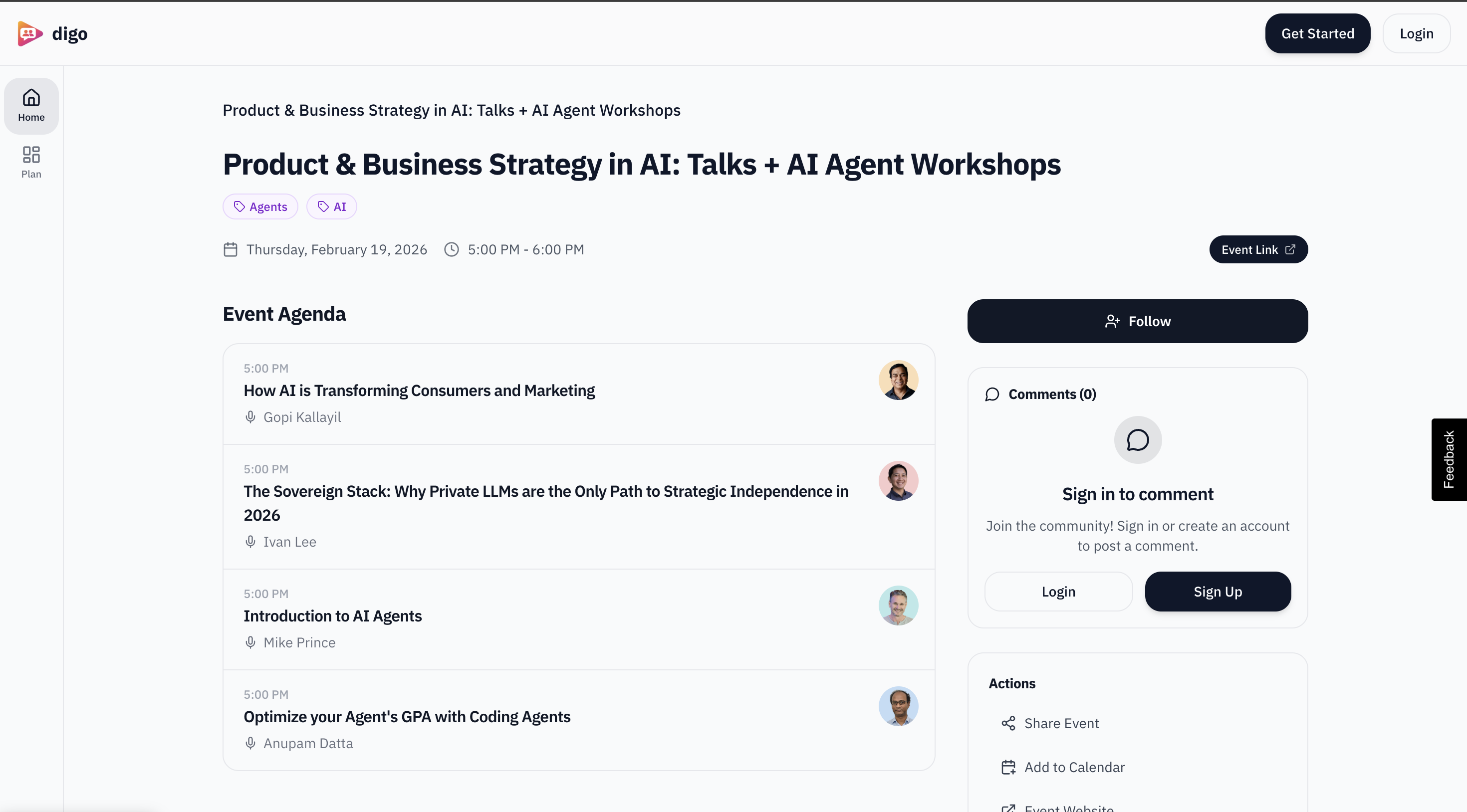
Student orgs, small businesses, and community groups waste 10+ hours per event on manual coordination, stitching together Google Forms, Sheets, email, Venmo, and group chats. Existing tools like Eventbrite solve ticketing, not the full event lifecycle. I interviewed 10+ event organizers and found that 40% of their time goes to admin tasks that could be automated, and the #1 pain point is last-minute changes that force manual updates across 4-5 disconnected tools.
Featured Case Study
Digo, AI Event Management Platform
Founding Product Manager
I mapped end-to-end workflows for organizers managing 5-50 events per year on limited budgets. The key insight was that the problem is not any single tool. It is fragmentation. Every change, whether that is a venue update, time shift, or speaker cancellation, cascades across forms, emails, and spreadsheets with no single source of truth. Competitive analysis confirmed that no affordable platform covers registration, communication, and real-time visibility together.
I used RICE scoring to prioritize the MVP around three high-impact features: automated event page creation with built-in registration, attendee communication and reminders, and a real-time organizer dashboard. I explicitly deprioritized payment processing and vendor management to v2. They scored high on reach but low on confidence because of integration complexity.
As the founding PM, I drove platform development from discovery through delivery. I owned product requirements, UX design in Figma, sprint planning, and user feedback sessions. Working closely with engineering, I prioritized features using RICE scoring and scoped sprints to weekly deliverables based on interview priorities. I also facilitated rapid iteration using AI-powered development tools like Cursor and GitHub Copilot.
- 50% reduction in manual event setup time for pilot users.
- Currently in MVP with active users testing the platform.
- Defined product roadmap through Q3 2026 with 12 planned features prioritized by user interview data.
What This Work Shows
This project captures how I work as a founding PM: start with workflow pain, get specific about the operational bottleneck, and cut scope until the MVP becomes sharp enough to ship.
The most important product decision was not adding features. It was deciding what to leave out so Digo could solve the highest-friction part of the organizer experience first.
← Back to selected work